
Connect samples, laboratory processing, sequencing, analyses and datasets — preserving the path from source material to conclusion.
The BioChain
Verifiable provenance across systems, organisations and evidence chains.
The BioChain provides a shared integrity layer for data and evidence that move between organisations — connecting laboratories, research systems, supply chains, field operations, sequencing platforms and existing databases, without replacing them.
Keep your systems. Connect their provenance.
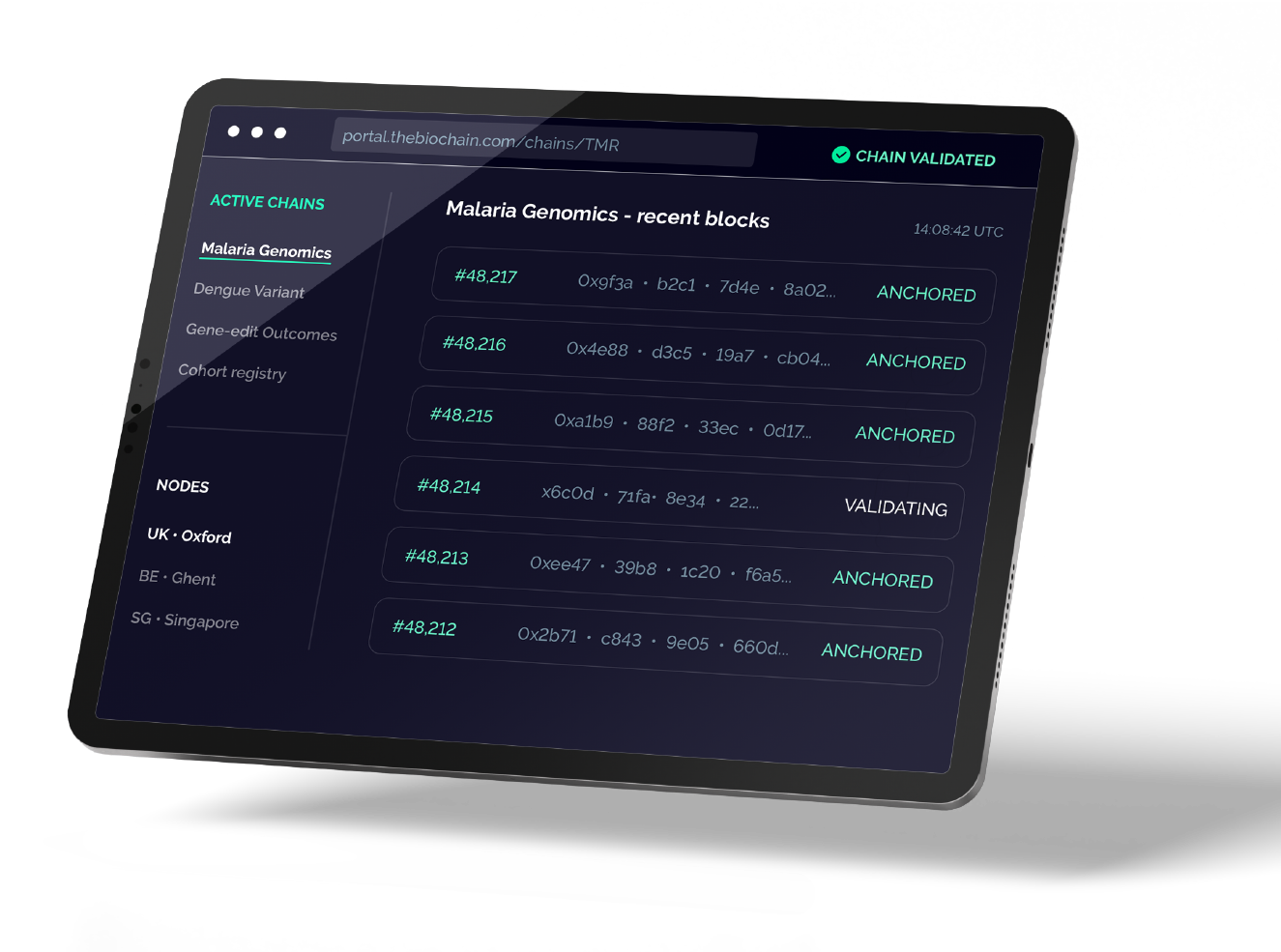
The BioChain validator dashboard
Private Deployment
Dedicated BioChain environments for organisations, programmes and consortia
Data Stays Where It Belongs
Sensitive and commercially valuable data remain in your own systems
Cryptographic Integrity
Tamper-evident records of important provenance events
API-First
Connect existing infrastructure without rip-and-replace
The Provenance Gap
The problem starts between systems.
Most organisations already have good systems of record. A laboratory may have a LIMS. A manufacturer may have an ERP. A sequencing provider may run its own pipelines. A farm may use herd-management software. Each system can maintain an excellent audit trail of what happens inside it.
The problem appears when evidence moves between them — a sample leaves one organisation and enters another, a laboratory result becomes an input to a different system, a sequence becomes evidence in an outbreak investigation. At that point, no single application's audit trail describes the complete history. Six good audit trails do not automatically add up to one verifiable end-to-end history.
Field & Collection
Laboratory & Processing
Sequencing & Analysis
Repository & Decision
Why BioChain?
When an audit trail is enough — and when it isn't.
If your data and its entire history remain within one trusted application, a well-designed database, audit trail and backup strategy may be all you need. The BioChain is designed for the point where provenance crosses applications, organisations, laboratories, jurisdictions or independent evidence sources.
Requirement
Existing system
The BioChain
See who changed a record
Audit trail
Supported
Recover data after failure
Backups
Not its purpose — available with hosted storage
Manage laboratory samples
LIMS
Integrates
Connect provenance across systems
Often fragmented
Designed for this
Connect provenance across organisations
Difficult to reconcile
Designed for this
Verify provenance outside the originating application
Usually limited
Independently verifiable
The BioChain starts where the individual audit trails stop.
How The BioChain Works
Five steps from fragmented evidence to verifiable provenance.
The BioChain connects the systems that already hold your evidence. It preserves the relationships between those records, establishes who or what made the assertions that matter, and makes the resulting provenance independently verifiable.
01Connect
02Structure
03Link
04Authenticate
05Verify
01Connect
Connect the systems that already hold the evidence — laboratory, research, operational and partner systems alike — through APIs rather than migration. Nothing is decommissioned and nothing is re-platformed, so each organisation carries on running the software it already depends on.
02Structure
Record and structure the provenance information, identifiers, relationships and selected evidence the chain depends on. Operational data can remain in the systems that already hold it — or, where an organisation would rather The BioChain held it, be stored within its own deployment, with backup and recovery options.
03Link
Join those records into a chain, so a sample connects to the processing, analysis and conclusion that followed it, including across organisational boundaries. The links preserve origin, version and history rather than flattening them, so a superseded result stays visible instead of being overwritten.
04Authenticate
Establish which organisation, person or system made an important assertion, and whether it held the authority to make it. Attribution is cryptographic rather than declarative, and authority is checked against the roles defined for the deployment rather than simply claimed by the party asserting it.
05Verify
Check the provenance, signature, version and integrity of the evidence, including whether anything has changed since. Verification works outside the application that originally presented it, so an auditor, regulator or partner need not trust that system in order to rely on what it recorded.
Verification does not make a false assertion true. It makes its origin, authority and history independently checkable.
Where BioChain Fits
One provenance layer. Many evidence chains.
Connect producers, batches, processors, laboratories and distribution — preserving the evidence linking products to testing and movement.
Connect farms, veterinary systems, diagnostics, sequencing and surveillance into a traceable evidence history.
Dedicated Deployment
Your organisation. Your partners. Your BioChain.
Private BioChain provides a dedicated environment for an organisation, programme or consortium. Your existing operational systems remain in place — The BioChain becomes the shared provenance and integrity layer between them.
Public Research Demonstrator
See The BioChain working.
The Ancient BioChain is a full working BioChain, running all five steps against publicly available research data, beginning with ancient DNA — a sample history that can span decades, institutions and technologies.