
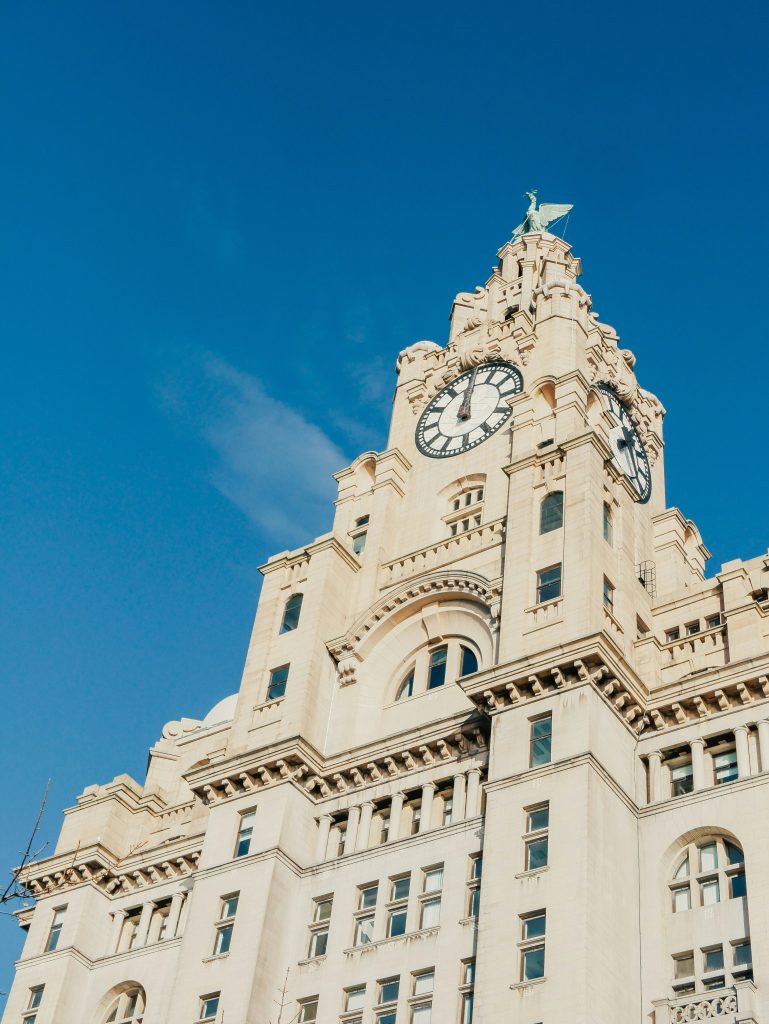
Opening The BioChain’s new office at Liverpool Science Park marks an important step for the company. For me personally, it also means something more: I am originally from Liverpool, so choosing the city as the next base for The BioChain carries a significance that goes beyond geography. Liverpool is part of my own story, and there is something deeply meaningful about bringing a new scientific and technology venture back to the city I am from.
A few weeks ago, in How The BioChain Is Built, we set out the thinking behind the company’s distributed structure and said we were actively working to close the gap between our head office in Oxford, our software hub in Ghent, and the applied scientific communities our platform is ultimately built to serve. Liverpool Science Park is that plan taking shape.
But the decision is not simply sentimental. Liverpool is also, quite simply, an increasingly compelling place for a company like The BioChain to be. The city has built a strong and distinctive ecosystem across health, life sciences, infectious disease, veterinary science, global health, data and innovation, and for a company whose work sits at the intersection of scientific evidence, provenance, genomics, infectious disease, research collaboration and One Health, that makes Liverpool a natural fit. Our new office at Liverpool Science Park will place us closer to researchers, universities, healthcare organisations, life-science companies and the wider innovation community, much as our Ghent office put us closer to European research and regulatory networks. For us, this is not simply about opening another office. It is about putting The BioChain closer to the science.
The BioChain is building infrastructure for scientific evidence. At its simplest, our work is about preserving the relationships between data, the people and organisations that generate it, the analytical processes that transform it, and the conclusions that ultimately depend upon it, a problem we set out in more depth in Who Owns the Evidence Chain?
Those relationships matter because modern science is increasingly distributed. A single research result may draw on samples collected in one country, sequencing performed in another, analytical pipelines developed elsewhere, reference datasets maintained by a third party and conclusions produced by teams spanning multiple institutions. The data may be stored and the final result may be published, but the evidence chain connecting everything in between can become fragmented. That is the problem The BioChain is working to address, and Liverpool provides an unusually relevant environment in which to develop that work.
The city and wider Liverpool City Region have established significant strengths in health and life sciences, while the Knowledge Quarter brings together universities, hospitals, research institutions and science-focused organisations within a relatively concentrated area. Liverpool is particularly strong in infectious disease, global health and veterinary science, fields where the integrity, traceability and interpretation of evidence can have direct scientific and public-health consequences. That matters greatly to us.
Scientific organisations already use sophisticated systems for managing information. Laboratory information management systems, research databases, sequencing platforms, biobanks, clinical systems and analytical pipelines all perform essential functions, and The BioChain is not being built to replace those systems. Instead, we are focused on a different question: how do we preserve a trustworthy account of the evidence moving between them?
Where did a sample originate, and who handled it? Which laboratory generated a particular result, using which version of which analytical pipeline, and which reference datasets contributed to the analysis? How did one observation become part of a wider scientific conclusion, and, months or years later, can another researcher reconstruct that chain well enough to understand and verify what happened? These are not abstract questions. They sit at the centre of reproducibility, scientific integrity, collaboration and trust, and as scientific research becomes increasingly computational and collaborative, preserving provenance becomes more important, not less, a theme we return to often, including in AI Cannot Fix Irreproducible Biology.
Liverpool’s particular strength in infectious disease is one of the reasons the city is so relevant to our work. Outbreak investigation and pathogen surveillance provide especially clear examples of why provenance matters. Consider a suspected infectious-disease outbreak: samples may originate from patients, livestock, wildlife, food, water or the wider environment, and those samples may move through diagnostic laboratories, sequencing facilities, reference laboratories and research institutions. Genomic data may then be compared with existing datasets and combined with epidemiological information before conclusions are drawn about transmission, origin or risk, a chain of reasoning we examine in more technical depth in Sequencing Is the Beginning, Not the End.
By the time a public-health or veterinary decision is made, a single conclusion may depend on dozens of separate pieces of evidence produced across multiple systems and organisations, and understanding that conclusion means understanding the chain behind it. That principle extends well beyond outbreak response: it applies to antimicrobial resistance, genomic surveillance, veterinary epidemiology, food safety, clinical research, biobanking and One Health, a boundary we explore directly in At the Wildlife-Livestock Boundary, Genomic Data Needs a Provenance Trail. Liverpool therefore offers something particularly valuable to The BioChain: proximity to scientific communities already working on exactly these kinds of complex evidence problems.
We do not see the Liverpool office simply as a place for desks. Its purpose is to create a physical base for scientific engagement and collaboration, and we want to build relationships with researchers, universities, hospitals, life-science companies, public-health organisations and others working with complex biological and scientific data. We are particularly interested in collaborations involving genomic provenance, infectious-disease surveillance, One Health, research reproducibility, biobanking, scientific data governance and multi-institutional research.
We also hope Liverpool will eventually become an important place for developing talent within The BioChain, including graduate opportunities, student placements, collaborative research projects and partnerships with researchers interested in exploring new approaches to scientific provenance. For a company working at the intersection of technology and science, those relationships matter enormously. Software alone does not solve scientific problems; you need to understand how researchers actually work, how evidence moves, and where information is lost and trust begins to break down. Being physically closer to those communities helps us learn.
One of the projects already helping us explore these questions is Ancient BioChain. Ancient biological data provides a surprisingly powerful environment in which to study scientific provenance: a single ancient sample may have been excavated decades ago, analysed by several laboratories, referenced in multiple papers, incorporated into later genomic datasets and reinterpreted repeatedly as methods improve. The underlying biological material remains the same, but the evidence surrounding it evolves, and reconstructing where a piece of information originated, how it was transformed and why it appears in a particular dataset can therefore become extremely difficult. Ancient BioChain allows us to explore how those relationships might be preserved more clearly.
But the underlying problem is not ancient. The same challenge exists in modern pathogen genomics, outbreak investigation, collaborative research and increasingly complex biological datasets. The organism may change and the technology may change, but the evidence problem remains remarkably similar. That is why our demonstrators matter: they allow us to explore difficult provenance problems in real scientific contexts while developing approaches that can later support much broader applications, an approach we also set out in The Minimum Evidence Record, v0.1.
Liverpool is also investing heavily in its future as a science and innovation economy. The wider region has identified health and life sciences as an important area for long-term growth, alongside digital technology, data and advanced innovation, and that matters because companies such as The BioChain do not develop successfully in isolation. Scientific infrastructure emerges from networks: universities generate knowledge, hospitals and laboratories generate evidence, technology companies build new capabilities, public institutions establish standards and policy, investors provide capital, and researchers, engineers, clinicians and entrepreneurs move between all of them. The most interesting innovation often occurs where those communities overlap, and Liverpool increasingly provides that environment. We want The BioChain to become part of it.
There is, of course, a personal dimension to all of this for me. Building companies inevitably involves thinking about where you want them to belong. Sometimes those decisions are purely commercial, sometimes they are driven by customers, talent or investment, and occasionally, however, the practical and the personal align. Liverpool is home for me, and it is also a city with serious scientific ambition and a growing life-sciences ecosystem that aligns extraordinarily well with what we are trying to build. That makes opening here feel less like choosing a location and more like finding the right place.
The BioChain is still at the beginning of its journey, and there is an enormous amount to build, test and learn. But as we develop technology intended to make scientific evidence more connected, traceable and trustworthy, we want to do that work alongside people who understand why those things matter. Liverpool gives us the opportunity to do exactly that.
So this is more than the opening of a new office. It is a return home, and, we hope, the beginning of a long relationship between The BioChain and Liverpool’s scientific community.
Welcome to The BioChain Liverpool.
Liverpool Science Park, in Liverpool’s Knowledge Quarter, alongside universities, hospitals and research institutions.
No. The BioChain already has a European R&D office in Ghent, Belgium; Liverpool is a second, UK-based addition.
Both personal and strategic reasons: it is CEO Ashley Morgan’s home city, and it has an unusually strong ecosystem in infectious disease, veterinary science, global health and life sciences.
Genomic provenance, infectious-disease surveillance, One Health, research reproducibility, biobanking, scientific data governance and multi-institutional research, plus graduate opportunities and student placements over time.
If your organisation generates, manages, analyses or governs biological evidence and would be interested in participating in a UK or European provenance demonstrator, The BioChain would welcome the conversation.
Get in touch


Regulatory developments, technical notes and platform news — sent occasionally, straight to your inbox.